
Platonic vs. Plutonic: Understanding Deep Friendship vs. Casual Connections
Not all close relationships are romantic. And not all connections are meant to carry deep emotional weight. Yet many people confuse the terms “platonic” and “plutonic” or worse, use them interchangeably. This guide clarifies the difference, explores the real meaning of platonic friendship, debunks the “plutonic” mix-up, and helps you navigate both meaningful friendships and casual arrangements with confidence.
At a Glance: Quick Comparison
| Relationship Type | Core Description | Key Feature |
|---|---|---|
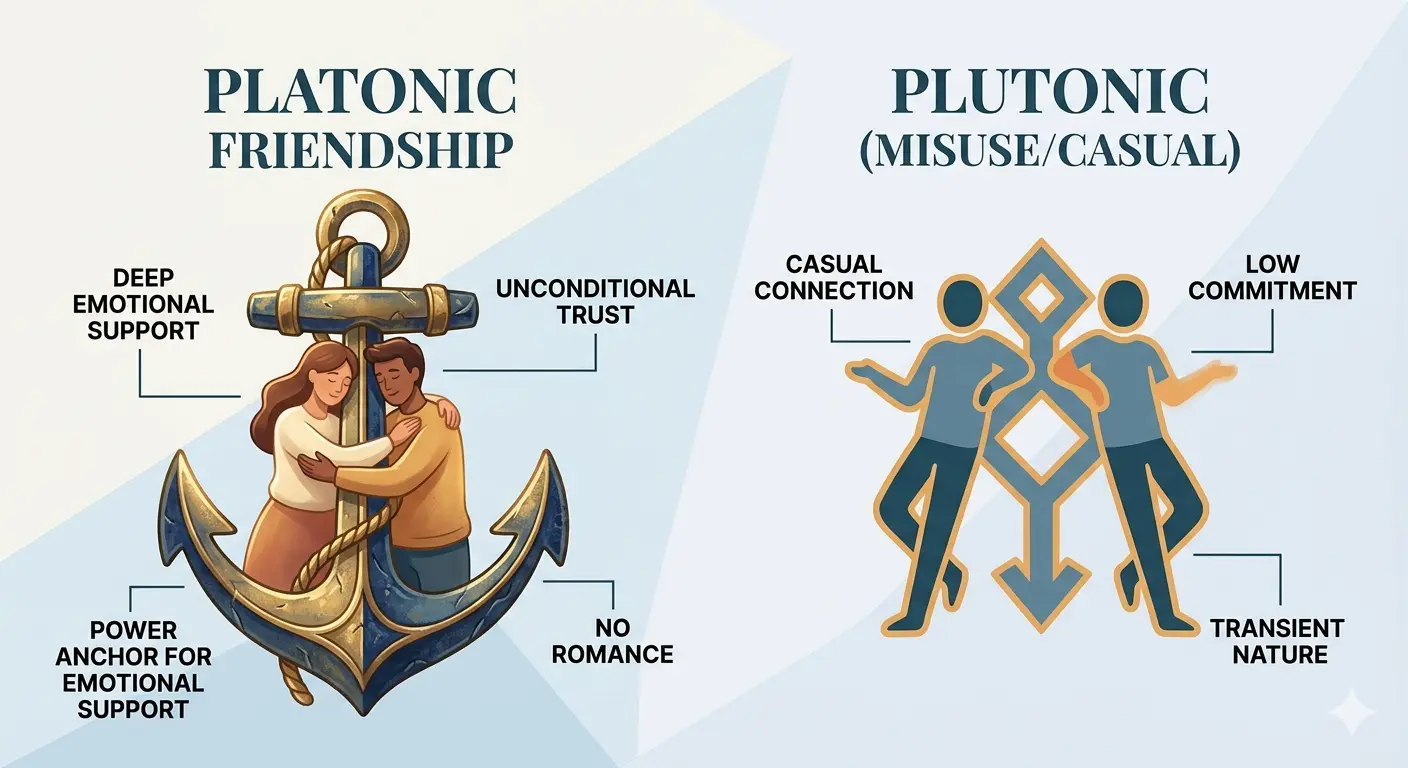
| Platonic | A deep, non-romantic friendship based on emotional closeness, trust, and genuine care for another person’s well-being and life goals | Emotional connection without romantic involvement |
| “Plutonic” (common misuse) | An informal term sometimes used to describe casual relationships without emotional commitment or interest beyond surface-level connection | Companionship without emotional investment |
What Is a Platonic Relationship?
A platonic relationship is a close, affectionate friendship that contains no romantic elements. The term comes from the Greek philosopher Plato, who in his work The Symposium described a form of connection that goes beyond surface-level attraction and focuses on intellectual and emotional bonds.
In everyday life, platonic relationships are the friendships where you feel truly seen, supported, and valued without any pressure or expectation of romance. These bonds often become the “chosen family” members who stand by you through life’s ups and downs.
The 5 pillars of a healthy platonic bond:
- Emotional safety – You can share fears, dreams, and vulnerabilities without judgment or hidden motives
- Unconditional support – Your friend cares about your well-being because they genuinely value you, not because of any romantic expectation
- Consistent reliability – These friendships are built on long-term trust, not fleeting chemistry
- Clear boundaries – Both people actively choose to keep the connection non-romantic, allowing the friendship to grow without complications
- Gender neutrality – Platonic friendships thrive across all genders and orientations when built on mutual respect
The “Plutonic” Confusion: What Does It Really Mean?
One of the most common mix-ups in online relationship discussions is the term “plutonic relationship.” To be clear: “plutonic” is not a recognized term in psychology or relationship science.
So where does it come from?
- In geology, “plutonic” refers to igneous rocks formed deep underground from cooled magma named after Pluto, the Roman god of the underworld.
- In astrology, a “plutonic” connection describes an intense, transformative dynamic linked to the planet Pluto’s energy.
When people use “plutonic relationship” online, they are almost always misusing the word. If someone means a casual, no-strings-attached arrangement without emotional depth, the more accurate and widely understood terms are “casual relationship” or “no-commitment connection” not “plutonic.”
Why does this matter? Using the right words helps you communicate your intentions clearly. When you seek a platonic connection, you are looking for a deep emotional anchor. Mixing up the terms can lead to mismatched expectations and unnecessary hurt feelings.
Key Differences in Perspective
Beyond the basic definitions, platonic and casual no-commitment relationships shape your emotional experience in very different ways:
| Aspect | Platonic Relationship | Casual / No-Commitment Relationship |
|---|---|---|
| Emotional fulfillment | Leaves you feeling cared for and supported on a deeper level | Temporarily satisfies companionship needs without deeper emotional reward |
| Trust level | Partners view each other as trusted allies to rely on through life changes | Partners often remain unfamiliar with each other’s emotional world |
| Longevity | Often withstands life transitions and stands the test of time | Usually fades once the initial interest cools |
| What you value | Personality, character, virtues, and uniqueness | Surface-level traits or immediate appeal primarily |
| Reciprocity | Mutual respect, learning, and nourishment | Risk of one party being taken for granted or used mainly for personal convenience |
Why the Distinction Matters for Your Emotional Health
Understanding the difference between seeking a deep emotional bond versus a purely casual arrangement is more than just theory it directly affects your well-being:
- Prevents mismatched expectations – One person may think they are building a meaningful friendship while the other sees a no-commitment connection.
- Protects your emotional energy – Knowing what you truly want helps you invest your time where it is most likely to be returned.
- Supports healthier boundaries – Clear understanding leads to clearer communication about what is and isn’t part of the relationship.
Research in behavioral psychology shows that strong platonic networks are linked to better mental health outcomes, including lower stress and greater life satisfaction. While casual connections have their place, the emotional well-being that comes from genuinely caring friendships deserves real attention.
How to Navigate Both Types of Dynamics Wisely
For Platonic Relationships
- Communicate boundaries openly – Have honest conversations about the nature of your friendship, especially if feelings ever begin to shift.
- Nurture the bond intentionally – Like any meaningful relationship, platonic friendships need time, effort, and mutual care.
- Practice self-awareness – Recognize when underlying attractions might risk changing a trusted platonic dynamic, and address those feelings respectfully.
For Casual No-Commitment Relationships (if you choose to engage in them)
- Be extremely clear from the start – Discuss that the arrangement is based on companionship without emotional partnership.
- Prioritize safety and consent – Ensure all interactions are safe, consensual, and respectful of both people’s boundaries.
- Check in regularly – Feelings can change over time. Low-pressure check-ins help ensure both people remain comfortable.
- Protect your emotional well-being – Be honest with yourself about whether casual dynamics are truly meeting your needs or leaving you feeling unfulfilled.
For Everyone
Clearly distinguishing between these relationship types empowers you to seek connections that match your true needs and values. Informed choices lead to greater relationship satisfaction and healthier interactions overall.
Frequently Asked Questions (FAQs)
Q: Can a platonic relationship turn romantic?
Yes. Many successful long-term partnerships started as platonic friendships. This transition should always include open communication so both people understand the risks to the original friendship.
Q: Is “casual no-commitment relationship” the same as a plutonic relationship?
The term “plutonic relationship” is not a standard psychological term. If someone uses it to describe a casual arrangement without emotional depth, “casual relationship” or “no-commitment connection” are clearer and more accurate terms.
Q: Can men and women truly be just friends?
Yes. Research and everyday experience show that cross-gender platonic friendships are not only possible but highly beneficial. The key is mutual respect, clear boundaries, and transparency especially when one or both friends are in romantic relationships with others.
Q: How do I tell someone I only want to be friends?
Clarity is kindness. A direct but gentle approach works best: “I really enjoy our time together, and I want to be clear that I see us as friends.” This prevents mismatched expectations and future hurt feelings.
Q: What if I develop romantic feelings for a platonic friend?
This is a common experience. First, reflect: Is this genuine romantic interest, or deep appreciation for their support? If it is romantic, consider whether acting on it is worth potentially changing the friendship. If you decide to share your feelings, do so respectfully and be prepared for any response.
Conclusion
Platonic relationships are among life’s greatest gifts deep, supportive connections that enrich our lives without the complications of romance. The informal misuse of “plutonic” as a relationship term creates unnecessary confusion; when people mean casual or no-commitment arrangements, those are the precise words to use.
The foundation of all healthy relationships remains the same: clear communication, mutual respect, and a commitment to shared growth. By understanding what you truly want and expressing it openly, you give yourself the best chance to build connections that are both fulfilling and aligned with your needs.
This article is for informational purposes only and does not constitute professional therapy or counseling. It is based on research and independent synthesis of relationship psychology. If you are facing serious relationship challenges, please consider speaking with a licensed therapist.
- American Psychological Association (2023). The science of why friendships keep us healthy. Monitor on Psychology, 54(4).
https://www.apa.org/monitor/2023/06/cover-story-science-friendship - Holt-Lunstad, J., Smith, T. B., & Layton, J. B. (2010). Social relationships and mortality risk: A meta-analytic review. PLOS Medicine, 7(7), e1000316.
https://journals.plos.org/plosmedicine/article?id=10.1371/journal.pmed.1000316 - Mayo Clinic Staff (2024). Friendships: Enrich your life and improve your health.
https://www.mayoclinic.org/healthy-lifestyle/adult-health/in-depth/friendships/art-20044860 - Pezirkianidis, C., et al. (2023). Adult friendship and wellbeing: A systematic review. Frontiers in Psychology.
https://doi.org/10.3389/fpsyg.2023.1059057

Furqan Kara is the founder of VeryWell Mindset, a platform dedicated to practical relationship research and personal growth. With 10+ years of marriage experience and a passion for studying behavioral psychology, Furqan focuses on evidence-based strategies for healthy living. He writes from a place of personal research and real-life trial and error, offering a grounded perspective for those looking to improve their mindset and their connections.