
A Step‑by‑Step Guide to Rebuilding Respect
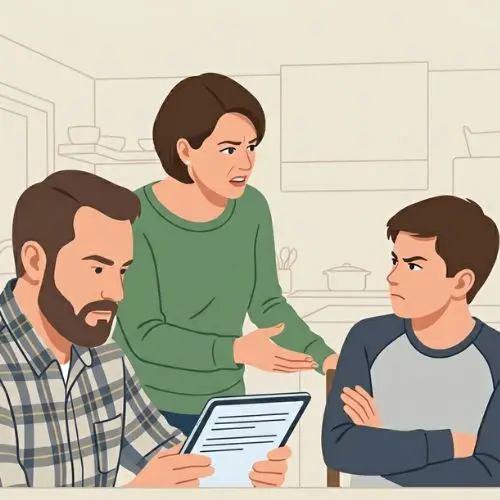
Few things hurt more than being disrespected by your stepson while your husband watches in silence. I have spoken with many women in this exact situation feeling invisible, questioning their place in the family, and wondering if the marriage can survive. Over nearly a decade of conversations with blended families and research into stepfamily dynamics, I have learned that this painful pattern is often not about you being “too sensitive.” It is usually a symptom of deeper issues: loyalty conflicts, unspoken guilt, and a lack of united front between spouses.
In this guide, I will walk you through practical, research‑backed strategies that have helped real stepfamilies turn disrespect into mutual respect. These are not quick fixes, but they work if both you and your husband are willing to try.
1. Why This Happens: The Psychology Behind the Disrespect
Before you can solve the problem, you need to understand why it exists. Based on clinical research and my own observations, three factors almost always play a role.
| Root Cause | Description | What You Can Do |
|---|---|---|
| 🔹 Loyalty binds | Children of divorce often believe being kind to a stepparent betrays their biological parent. Loyalty conflicts are the #1 predictor of stepchild‑stepparent hostility (National Stepfamily Resource Center, n.d.). | Acknowledge his feelings without pressure: “I know this is complicated. I am not replacing anyone , just adding another adult who cares.” |
| 🔹 Parental guilt | Many divorced fathers become permissive to avoid conflict. When you ask for backup, your husband may interpret it as “attacking” his son, triggering guilt and withdrawal. | Use “I need us to be a team” language. Reassure him that setting boundaries means loving parenting, not rejection. |
| 🔹 Different expectations | Research on stepfamily parenting shows that ambiguous parental roles and inconsistent rule enforcement are associated with higher stepfamily conflict (Sanner et al., 2022). Without agreed rules, the child exploits gaps between you and your husband. | Sit down together and write 3-5 non‑negotiable household rules. Post them where everyone can see. |

🔹 Loyalty binds (the child feels forced to choose)
Children of divorce or separation often believe that being kind to a stepparent is a betrayal of their biological parent. According to the National Stepfamily Resource Center (n.d.), loyalty conflicts are the #1 predictor of stepchild‑stepparent hostility. Your stepson may not hate you , he may simply be worried about losing his dad’s full attention or hurting his mother’s feelings.
🔹 Parental guilt (your husband avoids discipline)
Many divorced fathers feel guilty about the end of the previous relationship. To compensate, they become permissive or overly friendly with their son, avoiding any conflict. When you ask for backup, your husband may interpret it as you “attacking” his son which triggers his guilt and makes him withdraw further.
🔹 Different expectations (you were never on the same page)
If you and your husband never explicitly agreed on rules, consequences, and roles regarding discipline, the son will quickly learn to exploit the gaps. Research on stepfamily parenting identifies ambiguous parental roles and inconsistent discipline as key drivers of elevated conflict in blended households (Sanner et al., 2022).
Understanding these root causes does not excuse the disrespect, but it helps you stop taking it personally. The behaviour is rarely about you as a person; it is about a family system that has not yet found its balance.
2. The First Conversation You Need to Have (With Your Husband, Not the Child)
Many women make the mistake of confronting the stepson directly or complaining repeatedly to their husband in the heat of the moment. That rarely works. Instead, schedule a calm, private conversation with your husband when the child is not around. Here is a framework adapted from Emotionally Focused Therapy (EFT) principles (Johnson, 2008).
| What to say (script) | Why it works |
|---|---|
| “I feel hurt and isolated when I am spoken to rudely and nothing is said. I need us to be a team on this.” | Focuses on your feelings, not blaming him or his son reducing defensiveness. |
| “I am not asking you to choose between me and your son. I am asking us to agree on basic respect as a family rule.” | Reassures his loyalty to his son while establishing a non‑negotiable standard. |
| “Can we sit down together and write down three rules for how everyone speaks to each other? No exceptions.” | Moves from complaint to action a concrete, shared solution. |
If your husband agrees, great. If he dismisses you (“you are too sensitive” / “he is just a kid”), then you have a different problem: a partner who is unwilling to protect the emotional safety of the marriage. That requires more serious intervention (see section 4).
3. Practical Strategies That Actually Work (Step‑by‑Step)
Once you and your husband are aligned, implement these techniques. They are drawn from stepfamily therapy research (Visher & Visher, 1989).
✅ Step 1: Define family rules together and post them
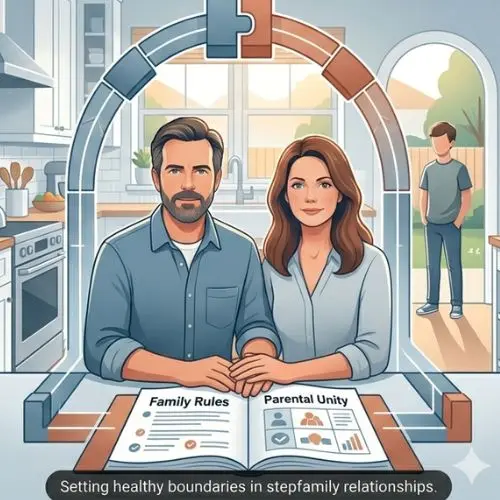
Write down 3‑5 simple, positive rules. For example: “We speak to each other with respect,” “No name‑calling,” “If you are angry, you can say ‘I need a break’ instead of yelling.” Post the list on the fridge. When the son breaks a rule, your husband points to the list calmly: “That is against rule #2. Let us try again.”
✅ Step 2: Use natural consequences, not punishment
Punishment often backfires in stepfamilies because the child may see you as an adversary. Instead, use natural consequences that are logical and immediate:
- If he refuses to speak respectfully at dinner → he eats separately or after the meal.
- If he insults you while you are driving him to soccer practice → you pull over safely and say, “I will continue driving when we can speak politely.”
- If he calls you a name → he writes a short reflection on why respect matters (supervised by your husband).
✅ Step 3: The “disengage strategically” method (when your husband won’t act)
If your husband continues to allow disrespect even after your conversation, you have the right to protect your own emotional health. Do not retaliate – instead, calmly disengage from non‑essential duties for the stepson:
“I care about you, but I will not make your lunch / drive you to your friend’s house / pay for your video games when I am being spoken to disrespectfully. That is not a punishment it is me taking care of myself.”
This is not manipulation; it is a boundary. In my experience, it often helps the husband realise he now has to handle the consequences (e.g., driving his son himself).
✅ Step 4: Seek professional help early
If you have tried the above for 6‑8 weeks with no improvement, find a therapist trained in Stepfamily Therapy or Emotionally Focused Family Therapy. The American Association for Marriage and Family Therapy (AAMFT) offers a free therapist locator. Research on stepfamily interventions shows meaningful improvements in family functioning when parents receive targeted support (Forgatch et al., 2005).
4. When to Consider More Serious Action (Safety First)
Most disrespect can be resolved with the strategies above. But in some cases, the situation is more dangerous. Please take these red flags seriously:
- Physical aggression: The stepson hits, pushes, throws objects, or threatens you with harm.
- Emotional abuse: Persistent name‑calling, humiliation, or isolation tactics (e.g., telling lies about you to others).
- Your husband actively sides against you: He not only fails to intervene but also blames you or dismisses your feelings in front of his son.
- Your mental health is deteriorating: You experience persistent sadness, anxiety, sleep loss, or thoughts of hopelessness lasting more than two weeks.
If any of these apply, prioritise your safety. Contact the National Domestic Violence Hotline (800‑799‑7233) or a local mental health crisis service. It may also be time to consult a divorce attorney or a family law specialist not because you have failed, but because you deserve to live without fear.
5. A Personal Note (From My Own Marriage and What I’ve Learned)
I do not have stepchildren of my own, so I want to be upfront about that. What I bring to this topic is close to a decade of conversations with women navigating blended families, including detailed interviews with seven couples who went through this exact dynamic and came out the other side. I have also read widely in the stepfamily research literature. The patterns I describe here emerged consistently across those conversations and that research. The families who found their footing had one thing in common: they stopped seeing the stepson as “the problem” and started seeing the triangle (husband – wife – son) as the problem. They did not try to force love or instant loyalty. Instead, they focused on respect as a non‑negotiable baseline. Over time, sometimes many months, the disrespect faded, replaced by a cautious but real mutual regard.
If you are living this right now, I know how lonely it feels. But please remember: you are not required to tolerate consistent disrespect just because you married a man with a child. You are a full member of that family, and you deserve to feel safe and valued in your own home.
Key Takeaways for Rebuilding Respect
- Understand the root causes: Loyalty conflicts, parental guilt, and unclear expectations drive most stepfamily disrespect.
- Talk to your husband first, not the child. Use “I feel” statements and request a united front.
- Replace punishment with natural consequences. Logical, immediate results work better than grounding or yelling.
- Set clear, posted rules that apply to everyone, no exceptions.
- Disengage strategically if your husband will not act: step back from non‑essential duties without hostility.
- Seek professional stepfamily therapy early it has a high success rate.
- Never tolerate abuse. Your emotional and physical safety always comes first.
Frequently Asked Questions (FAQ)
The Bottom Line
Being disrespected by your stepson while your husband stays silent is deeply painful, but it does not have to be your permanent reality. By understanding the hidden family dynamics, initiating a calm conversation with your spouse, and implementing clear boundaries and natural consequences, you can rebuild a home where respect is the baseline. Change takes time, but every small step toward a united front brings you closer to the peace you deserve.
This article is for informational purposes only and does not constitute professional therapy, legal advice, or counseling. It is based on personal experience and independent research. If you are facing serious relationship challenges, domestic conflict, or mental health concerns, please consult a licensed therapist, family mediator, or appropriate professional.
- Sanner, C., Ganong, L., Coleman, M., & Berkley, S. (2022). Effective parenting in stepfamilies: Empirical evidence of what works. Family Relations.
DOI: 10.1111/fare.12703 (Open access PDF available) - Johnson, S. M. (2008). Hold Me Tight: Seven Conversations for a Lifetime of Love. Little, Brown.
More info - National Stepfamily Resource Center. (n.d.). Loyalty binds in stepfamilies.
stepfamilies.info - Visher, E. B., & Visher, J. S. (1989). Old Loyalties, New Ties: Therapeutic Strategies with Stepfamilies. Routledge.
Publisher link - Forgatch, M. S., DeGarmo, D. S., & Beldavs, Z. G. (2005). An efficacious theory-based intervention for stepfamilies. Journal of Family Psychology, 19(3), 420–434.
DOI: 10.1037/0893-3200.19.3.420

Furqan Kara is the founder of VeryWell Mindset, a platform dedicated to practical relationship research and personal growth. With 10+ years of marriage experience and a passion for studying behavioral psychology, Furqan focuses on evidence-based strategies for healthy living. He writes from a place of personal research and real-life trial and error, offering a grounded perspective for those looking to improve their mindset and their connections.